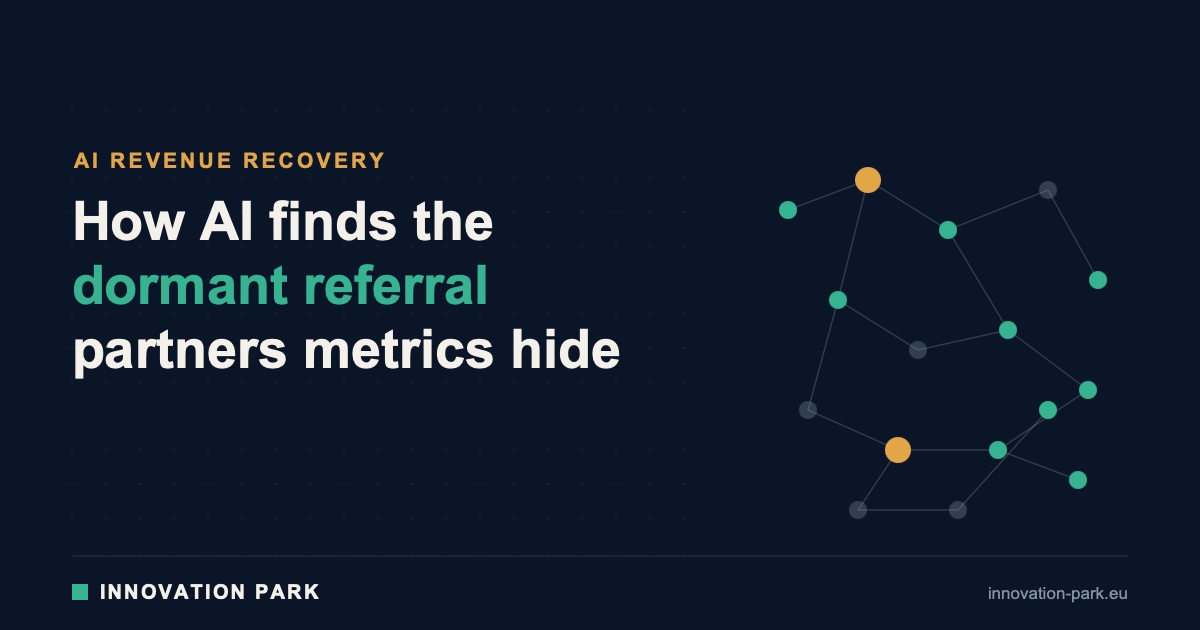
An aggregate referral count is a sum, and a sum cannot reveal which of its parts has gone quiet. Two branches with identical monthly admissions can have completely different underlying health: one with thirty active referrers, the other riding six while the rest go dormant. AI surfaces the difference by building a time-stamped graph of every relationship, scoring each source against its own historical cadence, and ranking the quiet ones by recoverable dollars. The output is a named, prioritised list, not a percentage. Median recoverable dormancy across 1,000+ audits: 34%.
- Aggregates average away the signal. A stable rollup can hide a collapsing referrer base because the healthy sources mask the dormant ones.
- Dormancy is a per-relationship question. It only appears when each source is measured against its own baseline, not the branch total.
- The AI's contribution is scale and consistency. Tens of thousands of independent baselines, scored the same way on every site.
- Concentration is the real risk. When a few sources carry a branch, the dormant majority is both the exposure and the recovery opportunity.
Why aggregates hide dormancy
Most multi-site healthcare operators measure referrals where the data is easy to read: at the branch rollup. The month closes, admissions are counted, and the number is compared to last month and to plan. If it holds, the relationship base is assumed healthy. That assumption is where the money leaks.
The problem is arithmetic. An aggregate is a sum, and a sum discards the composition that produced it. A branch admitting the same hundred patients a month can be doing it across thirty diversified referral relationships or across six that are quietly absorbing the load while two dozen others fade. The rollup reads identically in both cases. By the time the aggregate itself moves, the dormancy is no longer an early signal — it is a quarter of underperformance already booked.
This is why dormancy is structurally invisible in day-to-day reporting. The relationship lives in a liaison's inbox and on hospital floors, maintained in conversations that never reach a system. Nothing flags a source that used to send four patients a month and now sends one. The volume is still positive; it just stopped growing the way it should, and no aggregate is built to notice.
The time-stamped relationship graph
The fix is to stop looking at the total and start looking at the relationships. The AI ingests the operator's complete referral and pipeline history — not the active subset, the entire record, including sources that produced steadily years ago and have since gone quiet. Every interaction is time-stamped: last referral, last documented contact, last placement, historical volume and cadence.
That produces a graph in which each referral source is a node carrying its own history, rather than a row folded into a monthly sum. A gifted analyst would build exactly this for one location given unlimited time. The reason it takes AI is volume: a forty-community portfolio holds tens of thousands of relationships, each on its own rhythm, and dormancy only appears when all of them are held against their individual baselines at once. No human team can keep that many independent reference points in view. The system can, and it applies the identical logic on site one and site forty — the consistency that makes the result defensible in a board or diligence setting.
How much dormant referral revenue is your network carrying right now?
The Revenue Recovery Estimator uses the same benchmark dormancy rates as the diagnostic. Five inputs, sixty seconds, no email required.
Open the Revenue Recovery Estimator →Scoring dormancy and concentration risk
A graph by itself is description; the value is in the scoring. The system establishes each source's own baseline cadence from its history, then measures recent activity against that baseline. A source that historically sent four a month and now sends one is flagged, even though its volume is still positive — the comparison is to itself, never to the branch average. Each flagged relationship is then weighted by recoverable dollars and by its contribution to concentration risk.
Concentration is the part that tends to alarm a sponsor. When a branch runs on six sources instead of thirty, two things are true at once: the operation is fragile, because the loss of any one source is material, and the upside is large, because the dormant two dozen are recoverable revenue that was already earned once. The same scan that quantifies the risk quantifies the recovery. In the senior-living portfolio above, the top-to-bottom conversion variance on the same referrer base was 6.2×, and the dormant annual revenue identified came to $72M — a figure later confirmed by the client's own finance team.
What you do with the named list
The deliverable is not a dashboard and not a percentage. It is a ranked list of named relationships, each with its last-active date, a recoverable-value estimate, and the reactivation sequence: who reaches out, on what cadence, with what context. A referral coordinator can run it directly. Recovery does not replace the operator's revenue-cycle and CRM tooling — it tells that stack precisely where to point, which is the thing aggregate reporting could never do.
This is also why the work survives scrutiny. There is no platform claim to disprove, only a documented method, a named list, and a recovery number tied to specific relationships. A buyer's team can audit every step, and the worst they find is a method that works. The AI is the most replaceable part of the system; the relationships, scored against their own histories, are the asset.
FAQ.
Why can't aggregate referral numbers show a dormant partner?
Because an aggregate is a sum, and a sum hides its composition. A branch posting the same monthly admissions can be running thirty healthy relationships or six, with the rest gone quiet and the gap backfilled by a few overworked sources. The rollup is identical in both cases. Dormancy only becomes visible when each relationship is held against its own history, which a single aggregate number cannot do.
What is a dormant referral partner?
A referral source that historically sent business and has gone quiet without ever being formally lost. Nobody decided to end it; the referrals tapered as a contact changed or a liaison left. The revenue is recoverable precisely because the relationship was neglected rather than broken.
How does AI score dormancy?
It builds a time-stamped graph of every relationship, establishes each source's own baseline cadence, and flags the sources whose recent activity has fallen materially below that baseline. It then ranks them by recoverable dollars and concentration risk, producing a named list rather than a single percentage.
How to start.
Here is the fastest path to a real answer. No leap. A stair.
Run the Revenue Recovery Estimator
Five inputs. Sixty seconds. Sector-benchmark-calibrated dormant ARR range for your network. No email required.
Read the definition
What "AI for revenue recovery" actually means inside a healthcare portfolio — the practitioner-grade version that survives diligence.
Book a 30-min qualification call
Tyler Opsahl or Julia Vorontsova personally. We confirm fit, scope the diagnostic, and answer your data-handling and security questions. No pitch.