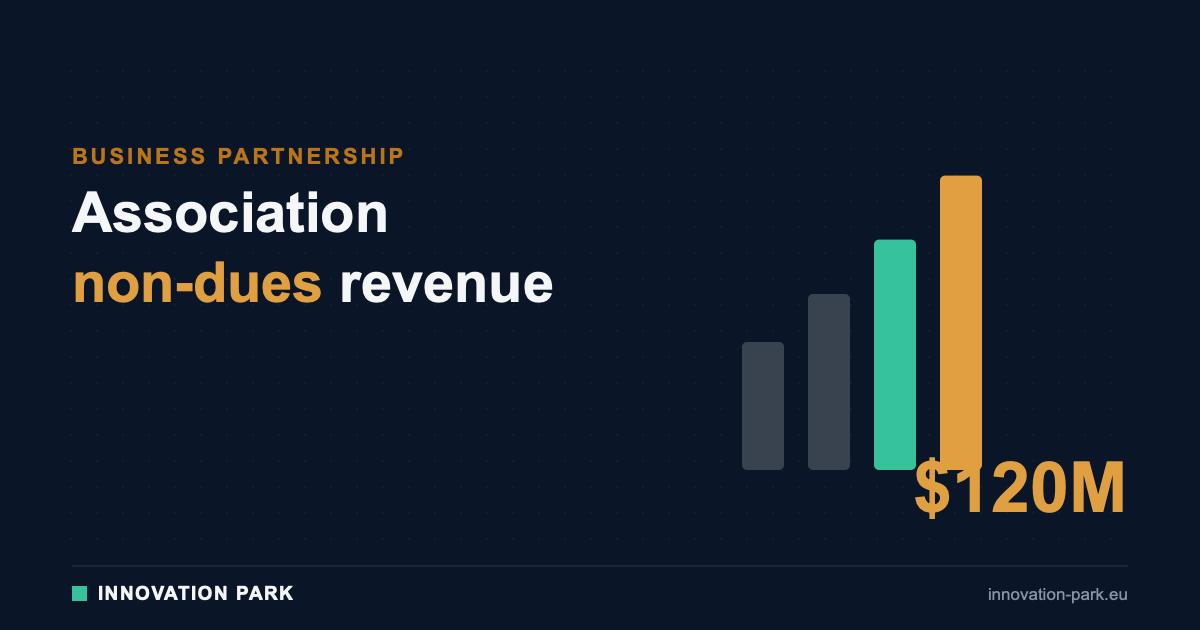
An association's largest untapped non-dues revenue source is usually a governed partner channel: vendors and service providers paying to reach a trusted member base through endorsed, managed partnerships rather than one-off sponsorships. Most programs underperform because they're run as transactional ad sales — no attribution policy, no active relationship management, no compounding member trust. Built as a governed channel that leads with genuine member value, it produces predictable, renewable, board-defensible revenue without raising dues. We built one for a 1,000+ member association that tracked $120M in member sales over 5–6 years.
- The asset is the network, not the newsletter. Partners pay for trusted access to members, not banner space.
- Sponsorship thinking caps the upside — one-off, hard to renew, impossible to value in aggregate.
- Governance turns it into a channel — attribution, member value, and active relationship management.
- Member trust is the moat — endorse only what serves members, and the asset compounds instead of eroding.
The asset associations overlook
Every association sits on something most companies would pay enormous sums to build: a trusted, defined network of members who actually listen to it. Partners — vendors, service providers, suppliers to the industry — want access to exactly that network, and they will pay for it. Yet most associations monetise this asset at the margins, through sponsorship packages and advertising, while the underlying network value goes largely uncaptured. The non-dues revenue conversation usually starts with "what can we sell?" when it should start with "what is our network worth as a channel?"
Why sponsorship thinking caps it
Sponsorship and ad sales are transactional by nature, and that nature imposes a ceiling. Each deal is negotiated fresh, priced on impressions rather than outcomes, hard to renew because it delivered nothing measurable, and impossible to value in aggregate because there is no governing framework behind it. Worse, transactional selling slowly spends the very thing that makes the network valuable: member trust. Sell members' attention to whoever pays, and the endorsement that partners are actually buying degrades. The transactional model both caps revenue and erodes the asset.
Building it as a channel
The shift is from selling access to building a governed channel. That means treating each partner as a durable, managed relationship with a clear definition of what it delivers to members and to the association, an attribution framework so the revenue it generates is measurable and renewable, and active relationship management so lapsing partners are reactivated rather than lost. It is the same partnership-systems discipline that makes any partner channel defensible — a written rule for what each partnership is, an audit trail for the revenue, and ownership of the relationship over time — applied to an association's unique asset. Built this way, non-dues revenue stops being a series of one-off sales and becomes a predictable line the board can underwrite.
What is your member network worth as a governed channel?
We'll sketch the channel model and the attribution framework for your association on a 30-minute call.
Book a 30-min call →Member trust is the moat
The discipline that separates a durable channel from a quick cash grab is leading with member value. A partner is only worth endorsing if it genuinely serves members; endorse on that basis and every partnership deepens trust, which makes the next partnership more valuable — the asset compounds. Endorse on the basis of who pays most and trust erodes, partners notice the declining engagement, and the channel decays. This is why an association partner channel cannot be run purely as a revenue function; it has to be run as a member-value function that produces revenue. Get that order right and the channel is not just lucrative but defensible, because no competitor can replicate the trust. That is the channel we build, governed end to end, with the partnership-systems methodology behind our work for a 1,000+ member association that tracked $120M in member sales over 5–6 years.
FAQ.
What is non-dues revenue for an association?
Income beyond membership fees — traditionally sponsorships, advertising, events, and affinity programs. The largest untapped source is usually a structured partner channel: vendors paying to reach a trusted member base through endorsed, governed partnerships rather than one-off sponsorships. Done well, it can rival dues without raising them.
Why do most association partner programs underperform?
Because they're run as transactional ad sales rather than a governed channel. Without a written attribution policy, clear member value, and active relationship management, partner deals are one-off, hard to renew, and impossible to value in aggregate — and the member trust that makes the network valuable is spent rather than compounded.
How do you build a defensible association partner channel?
Start from member value: endorse only partners that genuinely serve members. Add governance — a written policy for what each partnership delivers and how revenue is attributed, an audit trail, and active relationship management that reactivates lapsing partners. Built this way it produces predictable, renewable, board-defensible revenue without raising dues. We built exactly this for a 1,000+ member association, tracking $120M in member sales over 5–6 years.
How to start.
Here is the fastest path to a real answer. No leap. A stair.
Read the attribution pillar
The governance model that makes a partner channel's revenue defensible.
See the partnership practice
How Innovation Park builds and governs durable partner-revenue systems.
Book a 30-min qualification call
Tyler personally. We sketch the channel model for your association. No pitch.