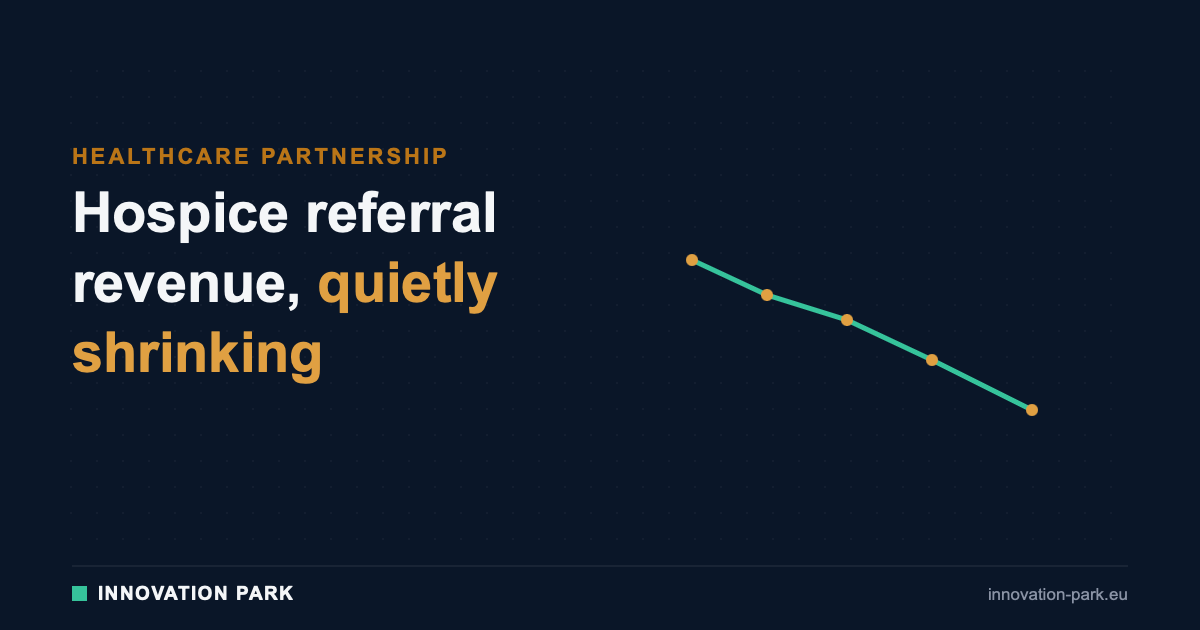
Hospice census often softens because the referral base is quietly shrinking, not because demand is. When eligibility scrutiny and documentation burden rise, some referrers hesitate and gradually stop referring; those relationships go dormant without ever being formally lost, and because each tapers rather than stops, no report flags it. They rarely return on their own. Recovery means reconstructing the referral history, scoring each source against its own baseline, and reactivating the quiet ones with the specific support that addresses their hesitation.
- Soft census is usually a referral-base problem dressed up as a market or regulatory one.
- Eligibility scrutiny creates hesitation, and hesitation quietly turns active referrers dormant.
- Dormant hospice referrers don't self-recover — re-engagement has to be deliberate.
- The fix is relationship-level, not a marketing campaign — find the quiet sources by name and address the specific friction.
What looks like a market problem
When a hospice's average daily census drifts down, the explanations reached for first are external: tougher eligibility enforcement, shorter lengths of stay, competition, demographics. Some of that is real. But in audit after audit, the larger and more fixable cause sits inside the organisation's own referral network — a base of relationships that has been quietly contracting while leadership watched the census number rather than the sources behind it.
The distinction matters because the two diagnoses lead to opposite actions. If the problem is the market, you cut capacity and wait. If the problem is a shrinking referral base, you reactivate relationships — and the revenue comes back. Misdiagnosing the first as the second is how hospices shrink permanently in a growing market.
How hesitation becomes dormancy
The mechanism is human. When eligibility documentation becomes more demanding and the consequences of a questionable referral feel higher, a busy physician or discharge planner does the rational thing: they hesitate. They refer the clear-cut cases and hold back on the ambiguous ones, then gradually refer less as the path of least resistance becomes referring elsewhere or not at all. No one decides to stop. The relationship just thins, visit by visit, until a source that once sent steadily sends nothing — and because hospice referrals are episodic by nature, the silence looks normal for far too long.
How much dormant hospice referral revenue are you carrying?
The free Revenue Recovery tool estimates it in 90 seconds using published sector benchmarks. No email required.
Open the free tool →Why your census report hides it
A census or admissions report is an aggregate, and an aggregate cannot show a dormant relationship — it can only show the sum once enough relationships have already gone quiet to move it. By then the erosion is months old and a quarter of your referrer base may be sending nothing. The information you need is one level down: each referral source measured against its own history, so a source that has fallen well below its established cadence is flagged while it is still recoverable rather than after it is gone.
Reactivating a hospice referral base
Recovery is specific, not a brand campaign. The Revenue Lens scan reconstructs the full referral history, scores every source against its own baseline, and surfaces the dormant ones by name with a recoverable-value estimate. The reactivation sequence then addresses the actual reason each went quiet — frequently eligibility confidence and documentation support, the very friction that caused the hesitation in the first place. Done well, re-engagement does not just recover volume; it makes you the easiest hospice to refer to, which compounds. All of it runs inside your existing CRM and referral-management tooling. On qualifying $30M+ engagements, our 3× fee recovery guarantee applies: we recover at least three times our fee, or we keep working at no additional fee until we do.
FAQ.
Why is our hospice census declining when the market is growing?
Usually because the referral base is quietly shrinking, not demand. When eligibility scrutiny and documentation burden rise, some referrers hesitate and gradually stop; those relationships go dormant without being formally lost, and because each tapers rather than stops, no report flags it. The market grows while your specific network erodes.
Do hospice referrers come back on their own?
Rarely. A referrer who stopped has usually redirected elsewhere or fallen out of the habit. Without deliberate, contextual re-engagement the relationship stays dormant indefinitely. The revenue is recoverable because the relationship was neglected, not broken — but recovery requires reaching out, not waiting.
How do you recover dormant hospice referral revenue?
By reconstructing the referral history, scoring each source against its own baseline to surface the quiet ones, ranking them by recoverable value, and running a reactivation sequence that addresses the specific hesitation — often eligibility confidence and documentation support — inside the existing tooling.
How to start.
Here is the fastest path to a real answer. No leap. A stair.
Run the free tool
Five inputs. Sixty seconds. A benchmark-calibrated dormant-revenue range. No email required.
The discharge-planner parallel
The same dormancy mechanism in home health — and how reactivation works.
Book a 30-min qualification call
Tyler personally. We scope the diagnostic against your referral base. No pitch.