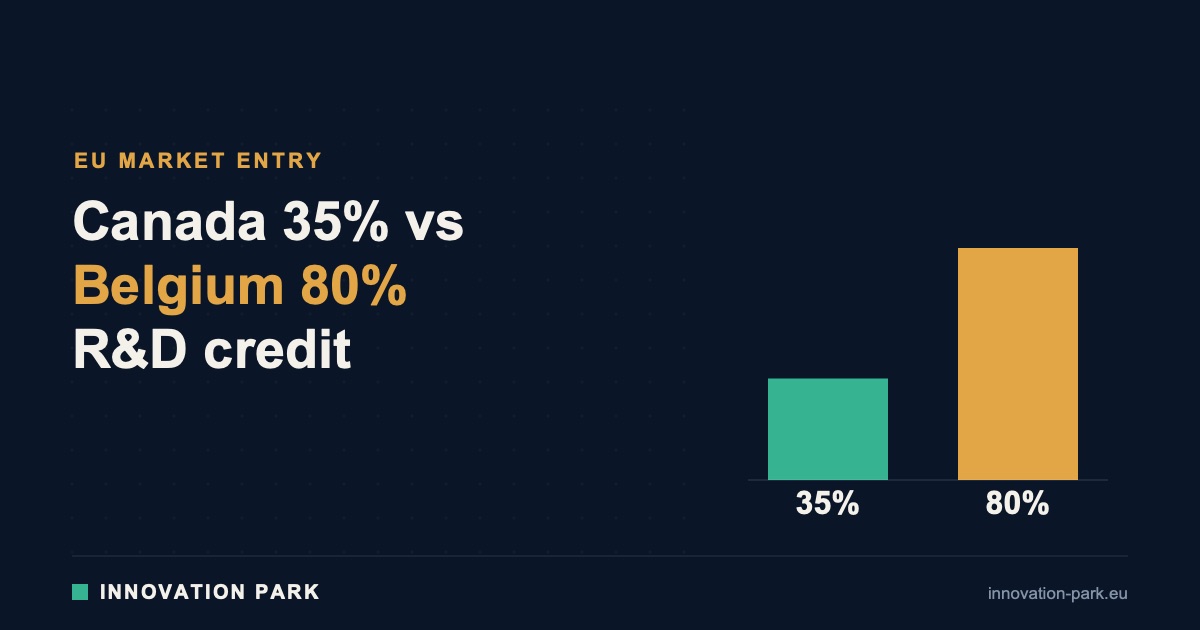
Canada's 35% is a tax credit on eligible R&D expenditure — money you spent, partially returned. Belgium's 80% is a wage-withholding exemption — money you never remit to the government in the first place, and it applies only to researcher salaries, not total R&D. Measured on the same basis (benefit as a percentage of total R&D cost), Belgium's wage exemption is worth roughly 8–12% — comparable to a Canadian provincial top-up, not the federal credit. Belgium's real advantage is the additional layers: VLAIO grants (25–50%), the Innovation Deduction (85%, a ~3.75% effective rate on IP income), and Horizon Europe co-funding (70–100%) that Canadian entities cannot access.
- The 80% headline is not the number that matters. What matters is the effective benefit as a share of total R&D — in Belgium roughly 8–12% from the wage exemption alone, comparable to a Canadian provincial top-up, not the federal credit.
- Canada wins on primary-incentive certainty. SR&ED is a refundable credit for CCPCs: spend on eligible R&D and you get it. VLAIO grants are competitive — you might not.
- Belgium wins decisively on Horizon Europe access. A Belgian entity can join Horizon Europe consortia as an EU beneficiary, typically receiving 70–100% co-funding. No Canadian entity can access this, regardless of CETA.
- It is not either/or. A company with a Canadian HQ and a Belgian subsidiary can claim SR&ED on Canadian R&D and VLAIO grants on Belgian R&D simultaneously — different jurisdictions, different costs.
- Belgium's wage exemption is immediate; SR&ED is delayed. The Belgian benefit appears in monthly payroll cashflow; SR&ED refunds arrive 12–18 months after expenditure.
SR&ED (Scientific Research & Experimental Development). Canada's primary federal R&D incentive since 1985. A tax credit on eligible R&D expenditure — wages, materials, and overhead. Canadian-Controlled Private Corporations get a 35% refundable credit on the first $3M of eligible spend; non-CCPCs (most foreign-owned subsidiaries) get 15% non-refundable. Provincial credits add 4.5–10% on top.
Wage withholding exemption. Belgium's primary R&D incentive. Employers normally remit withheld payroll tax to the authority; for qualifying researchers (bachelor's degree or higher on eligible projects) they keep 80% of that withheld amount instead. It is an immediate, monthly cash benefit — not a year-end filing — but it applies only to the wage base, which is why its effective value on total R&D cost is roughly 8–12%.
What each system actually is
Canada's SR&ED is a tax credit on eligible R&D expenditure — researcher wages, materials consumed in the R&D process, and a portion of overhead; subcontracted R&D is included at 80% of cost. CCPCs receive a 35% refundable credit on the first $3M of eligible expenditure and 15% above; non-CCPCs receive 15% non-refundable. Provincial credits add 4.5–10% depending on province, with Quebec, Ontario, and British Columbia the most generous.
Belgium's primary incentive is structurally different. It is not a credit on expenditure — it is an exemption from employer wage-withholding obligations for qualifying R&D staff. Belgian employers normally withhold a portion of wages and remit it to the tax authority (Bedrijfsvoorheffing). For qualifying researchers, employers are exempted from remitting 80% of that withheld amount. They still collect it from the employee — but they keep it.
The practical catch on the Canadian side: the eligibility determination is rigorous. CRA requires contemporaneous documentation of the scientific uncertainty addressed and the technological advancement sought; audits are common. The base, the mechanics, and the practical outcome differ in every dimension.
Why the two numbers are not comparable
When compared on the same basis — benefit as a percentage of total R&D cost — Canada's SR&ED is often more generous than Belgium's wage exemption alone. Belgium's advantage is the additional layers stacked on top.
The Innovation Deduction (Innovatieaftrek) gives an 85% deduction from taxable income on net income derived from patents and protected IP developed in Belgium — roughly a 3.75% effective rate on qualifying IP income. VLAIO (Flanders Innovation & Entrepreneurship) provides direct cash grants of 25–50% of eligible R&D project costs for approved projects. And Belgian companies in Horizon Europe collaborative projects receive EU funding that typically covers 70–100% of project costs, with no equity dilution.
The key insight: Canada's headline credit is more certain, but Belgium's stack — VLAIO grants, Innovation Deduction, and Horizon Europe access — compounds in ways a Canadian entity simply cannot replicate.
The real dollar calculation, step by step
Take a hypothetical North American B2B software company with five R&D researchers and an annual R&D budget of USD $500,000 (≈ CAD $680,000 or €460,000 at 2026 rates).
Canada (CCPC, Ontario): 35% × CAD $680,000 = CAD $238,000 federal credit, plus an Ontario provincial top-up (~8%) ≈ CAD $54,400. Total ≈ CAD $292,000 (USD ~$215,000) — a 43% effective return.
Belgium: Researcher wages are ~€330,000 of the €460,000 total. The wage-withholding exemption returns ≈ €29,040 (USD ~$32,000) — the monthly cash benefit. Add a VLAIO grant at 35% of €460,000 ≈ €161,000 (USD ~$175,000), if approved. Belgium Year 1 total ≈ USD $207,000 — a 41% effective return.
Year 1 is roughly equivalent — Canada slightly ahead if the VLAIO grant is secured. But over a three-year programme that includes Horizon Europe participation, Belgium's cumulative benefit substantially exceeds Canada's, because Horizon co-funding effectively doubles or triples available R&D resources without additional company investment.
The decision is rarely about the headline rate — it is about where your R&D output gets commercialised.
If you have European market ambitions, building R&D in Flanders creates the commercial and regulatory base that accelerates EU entry. See how the institutional path works.
See the EU Market Entry approach →How to access each programme
Canada SR&ED: Confirm CCPC status (it determines the 35% vs 15% rate), document R&D activities contemporaneously — CRA requires records of the scientific uncertainty, systematic investigation, and technological advancement — and file Form T661 with your corporate tax return. Most companies engage an SR&ED consultant (10–25% of the credit) for the first claim.
Belgium: Establish a Belgian entity — a BV can be incorporated in 2–4 weeks with a notary, minimum share capital €1. Identify qualifying researchers (bachelor's degree or higher on eligible projects), then register the R&D project with the relevant authority before claiming the wage exemption. VLAIO grant applications run 3–6 months and are materially stronger with a Flemish university or research-institute partner.
This is exactly where institutional access changes the outcome: VLAIO grants, Horizon consortia, and university partnerships all run on relationships, not cold applications.
Horizon Europe. The EU's flagship research and innovation programme (2021–2027, €95.5B budget). Belgian-based entities can join consortia as EU beneficiaries and receive 70–100% co-funding with no equity dilution — funding no Canadian entity can access directly, even under CETA.
FAQ.
Is Belgium really more generous than Canada for R&D?
Not on the headline incentive. Canada's 35% SR&ED credit, measured as a percentage of total R&D cost, is often more generous than Belgium's 80% wage-withholding exemption — because the 80% applies only to withheld payroll tax on researcher salaries, giving an effective benefit of roughly 8–12% of total R&D. Belgium becomes more generous when you stack VLAIO grants, the Innovation Deduction, and Horizon Europe co-funding, which a Canadian entity cannot access.
What is the difference between Canada's SR&ED and Belgium's wage exemption?
SR&ED is a tax credit on eligible R&D expenditure (wages, materials, overhead), received after filing — refundable for CCPCs. Belgium's incentive is a wage-withholding exemption: employers keep 80% of the payroll tax they would normally remit for qualifying researchers, as an immediate monthly cash benefit. One is a credit on what you spent; the other is tax you never hand over.
Can a company claim both SR&ED and Belgian R&D incentives?
Yes. A company with a Canadian headquarters and a Belgian subsidiary can claim SR&ED in Canada on Canadian R&D costs and VLAIO grants plus the wage exemption in Belgium on Belgian R&D costs simultaneously. The programmes do not conflict — they are in different jurisdictions covering different costs.
How much is the Belgian wage exemption worth in real dollars?
On a team with ~€330,000 in qualifying researcher wages, at an ~11% average withholding rate, total withholding is ~€36,300; the 80% exemption lets you retain ~€29,040 per year (USD ~$32,000). This is a monthly cash benefit, not a year-end refund. The larger Belgian numbers come from stacking VLAIO grants and Horizon Europe co-funding on top.
Why can Belgian companies access Horizon Europe but Canadian ones cannot?
Horizon Europe co-funding (70–100% of project costs) is available to entities with a legal presence in an EU member state. A Belgian subsidiary qualifies as an EU beneficiary; a Canadian entity does not, regardless of the CETA trade agreement, which covers trade access rather than R&D co-funding. This is the single biggest structural advantage of a Belgian base for R&D-heavy companies.
How to start.
If you are weighing where to build your European future, here is how to pressure-test Belgium against your own IP and clinical strategy — without committing to anything.
See how EU Market Entry works
The institutional path through Belgium — VLAIO, imec, EIT Health, Horizon Europe, UZ Leuven — and the Belgian tax architecture (3.75% effective IP rate, 80% R&D payroll retention).
Book a 30-min EU entry call
Julia Vorontsova personally, from Antwerp. We confirm whether Belgium fits your IP and clinical strategy, and map the institutional path. No pitch.
See the proof
Enlipsium: 13 institutional partnerships, 3 structured contracts, $50M+ pipeline, EU cancer-centre deployments in 12 months. Arini: 10 senior institutional meetings in Q1.