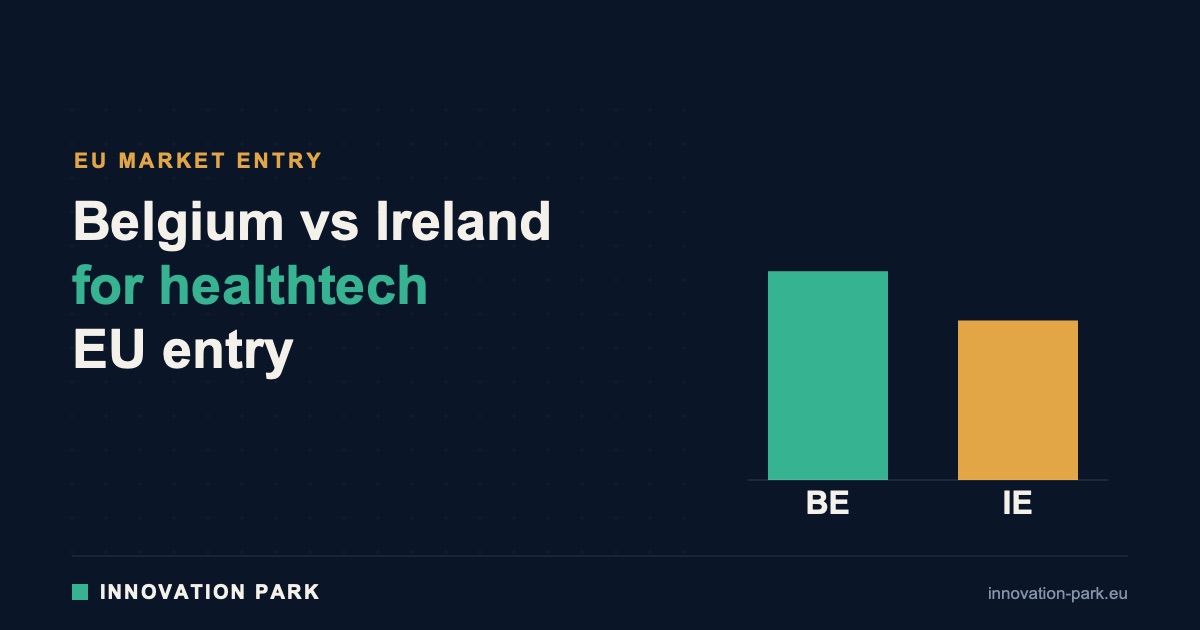
For a healthtech company entering Europe, Ireland optimizes for speed and Belgium optimizes for depth. Ireland offers low corporate tax, English-speaking operations, and a fast, familiar landing — which is why the big device makers manufacture there. Belgium offers something different: the world's fastest clinical-trial approvals (18–26 days), the #1 Horizon Europe research university (KU Leuven, €247M across 418 projects), and a tax architecture that taxes qualifying innovation income at roughly 3.75% while letting companies retain up to 80% of R&D payroll withholding. If your long-term value lives in IP, clinical evidence, and EU institutional credibility, Belgium is where it is built — provided you can access the ecosystem.
- Ireland operates; Belgium builds. Ireland's roster (Medtronic, Boston Scientific, Abbott, Stryker) manufactures and distributes. Belgium's (Janssen, UCB, GSK, argenx) invents, owns IP, and scales it globally.
- Belgium punches absurdly above its weight. €79B in annual pharma exports and ~19.3% of EU pharmaceutical R&D output — from 11.7 million people. Fourth-largest pharma exporter on earth.
- The tax architecture is the real moat. A ~3.75% effective rate on qualifying innovation income (Innovation Income Deduction) plus up to 80% R&D payroll-withholding retention — worth ~€15,000 per researcher per year.
- Leuven is the gravity well. KU Leuven is the #1 Horizon Europe grant winner globally; UZ Leuven is taking €230M in fresh EIB investment; imec posted €1.03B revenue in 2024.
- Infrastructure without access is just geography. Belgium's complexity defeats most cold entrants. The companies that win arrive with institutional relationships already in place.
Innovation Income Deduction (IID). Belgium's headline IP incentive. Companies deduct up to 85% of qualifying net innovation income tied to R&D-developed IP, cutting the effective rate on that income to roughly 3.75% against the 25% standard corporate rate — among the lowest IP rates in the developed world (per EY, PwC, and Osborne Clarke 2024–25 analyses). Applies to patents, R&D-developed software, orphan-drug and data exclusivities; unused deductions carry forward indefinitely.
The 80% R&D payroll incentive. Belgium lets companies running qualifying R&D retain up to 80% of the payroll withholding tax for eligible researchers (master's/PhD in applied science, medicine, or engineering). The researcher is paid in full; the company keeps 80% of the withheld tax instead of remitting it — averaging up to €15,000 per researcher per year, with no cap on headcount.
Ireland feels easy. Belgium feels important. Which matters more?
Ireland is excellent at helping foreign companies land softly. Belgium is excellent at helping innovation become structurally embedded into European healthcare systems. Those are not the same thing.
Ireland helps you enter Europe quickly, build commercial momentum, establish operations, hire internationally, and scale multinational relationships. Belgium helps you integrate into EU healthcare ecosystems, build clinical credibility, develop institutional partnerships, leverage research infrastructure, and position near European decision-making.
One is optimized for speed. The other is optimized for depth. The question is not which is better — it is which one matches where you are actually trying to go.
Why did Ireland become a medtech giant?
Ireland engineered itself into a medtech powerhouse over decades of deliberate policy — low corporate tax, aggressive foreign-investment recruitment, and world-class talent pipelines. Medtronic runs its European hub from Dublin; Boston Scientific employs over 5,000 across Galway and Cork; Abbott and Stryker both run major operations.
The ecosystem is real: Enterprise Ireland, IDA Ireland, the Irish Medtech Association (450+ companies), BioInnovate Ireland, and Health Innovation Hub Ireland. The country hosts over 450 medical-technology companies employing more than 45,000 people — the largest medtech employer per capita in Europe, with nine of the world's top ten device makers present.
The model is clear: Ireland competes on ease of entry, tax efficiency, talent access, and cultural familiarity. For a clean, fast European landing, it delivers reliably. The honest question is what comes after landing.
What makes Belgium a quiet healthcare powerhouse?
Belgium does not market itself like Ireland. Instead it built something harder: an interconnected healthcare-innovation engine that runs on institutional depth rather than promotional infrastructure.
The numbers most founders have never seen in one place: Belgium exports €79 billion in pharmaceutical products annually (2024), roughly 19.3% of total EU pharmaceutical R&D output — from 11.7 million people. It is the fourth-largest pharmaceutical exporter in the world, behind Germany, Switzerland, and the United States. Chemistry, pharma, and biotech make up 40% of all Belgian patents filed at the European Patent Office — the highest such share of any country. And Belgium has the fastest clinical-trial approval process in Europe: Phase I and II approvals in 18–26 days, making it the world's number-one location for clinical trials per capita.
This is not a country that stumbled into healthcare. It is the result of deliberate, sustained system-building across research, regulation, infrastructure, and tax policy — compounding over decades.
Why does Leuven matter more than entire countries?
Most outsiders have never heard of Leuven. That is a mistake. It integrates world-class university research, advanced clinical infrastructure, AI and semiconductor innovation, translational medicine, biotech, medtech, and digital health into one tightly connected system. Everything overlaps — and that overlap creates innovation density, which is where breakthroughs actually happen.
The core institutions: KU Leuven, the #1 Horizon Europe grant-winning university globally; UZ Leuven, Belgium's largest university hospital; and imec, the world-leading nanoelectronics and digital-health research center — €1.03B revenue in 2024, 5,500+ researchers, 600+ industry partners including ASML, Intel, and TSMC, and Belgium's top patent applicant two years running. Around them sit Leuven MindGate, the MEDVIA medtech cluster, Flanders Investment & Trade, and lifetech.brussels.
KU Leuven has secured €247 million across 418 Horizon Europe projects, coordinating 176 directly — no European university has won more. Europe is not casually supporting Leuven; it is strategically backing it, repeatedly, at the highest funding levels available.
Horizon Europe. The EU's flagship research and innovation programme (2021–2027), with a €95.5 billion budget. A university's Horizon performance is the clearest public signal of where Europe believes innovation will happen next — and KU Leuven leads it.
Why is UZ Leuven more important than many innovation districts?
UZ Leuven is Belgium's largest university hospital — but more importantly, it is deeply integrated into research, AI-health, and translational medicine in ways few comparable institutions are.
The European Investment Bank approved a €230 million financing package (January 2025) for UZ Leuven's "Health Sciences Campus 2.0" masterplan through 2031: ICU modernization, advanced theatres, imaging, nuclear medicine, biobank infrastructure, new pharmaceutical production, and translational-research expansion. This follows a prior €325M EIB loan from 2008. In December 2025 the EIB extended a further €120M to the university's connected mental-health network, part of a €270M programme running to 2040.
This is not cosmetic healthcare spending. It is Europe systematically investing in the infrastructure where the next generation of healthcare will be built — and Leuven is the address it keeps choosing.
The difference between Belgium working and Belgium frustrating you is access — and whose access.
Innovation Park holds direct, pre-established relationships inside UZ Leuven, the Flemish medtech ecosystem, and Flemish government channels. See how EU market entry through Belgium actually works.
See the EU Market Entry approach →Does Belgium attract a different kind of company than Ireland?
Ireland's roster is built around companies that manufacture and distribute in-country. Belgium's is built around companies that invent, develop, and own IP in-country — then scale it globally.
Johnson & Johnson / Janssen was born in Beerse, Belgium in 1953; J&J acquired it in 1961 and never moved it. The Belgian campus employs 5,309 people including 2,458 researchers, and J&J launched its JLINX startup incubator directly on that campus. UCB, headquartered in Brussels since 1928, reinvests 25–30% of revenue into R&D and completed a €300M+ biomanufacturing plant in 2024. GSK runs one of the world's largest vaccine facilities at Rixensart and Wavre. argenx, built on Belgian university science, is now a €20B+ immunology company. Galapagos grew out of KU Leuven spinoff science.
Medtronic ships devices from Ireland. Janssen creates the molecules from Belgium. The scale is comparable; the type of value created is not. Ireland is where global healthcare comes to operate. Belgium is where it comes to build — and for a company whose value lives in IP and clinical evidence, that distinction is everything.
Is Belgium's real superpower geography or tax strategy?
Most founders only hear about Ireland's corporate-tax rate. Sophisticated healthcare companies care about something more strategic: innovation taxation — and Belgium built one of Europe's most powerful systems for exactly that.
Consider a healthcare product that sells for €70: perhaps €20 reflects manufacturing and operational value, and €50 reflects patented algorithms, proprietary software, clinical IP, diagnostic logic, and embedded innovation. Belgium's Innovation Income Deduction explicitly recognizes that embedded IP value — so the innovation-related portion of the margin qualifies for the ~3.75% effective rate. Modern healthtech value increasingly lives in software, AI, data, and diagnostics, and Belgium's entire tax architecture is structurally aligned with that model.
It is not a loophole. Belgium follows OECD nexus rules without exception: the deduction is a ratio of qualifying domestic R&D against total global R&D, and companies must perform real local R&D with genuine researchers and demonstrable Belgian substance. Belgium registered 417 pharma and biotech patent filings in 2024 — genuine output, not tax arbitrage. That is exactly why serious companies cluster there.
OECD nexus rules. The international standard preventing IP-tax abuse. A company can only benefit from a regime like Belgium's IID in proportion to the genuine R&D it actually performs locally — measured as qualifying domestic R&D over total global R&D. Real researchers, real development, real substance required.
What is Belgium's biggest weakness?
Belgium itself. It is genuinely complicated — multiple languages, regional governance, layered healthcare systems, consensus-driven processes, and slower decision cycles. It can frustrate North American operators. This is not Silicon Valley speed, not even close.
But most foreign companies fail in Belgium not because the ecosystem is weak — they fail because they enter cold, without the relationships, institutional trust, and navigational knowledge that turn Belgium's complexity from a barrier into a moat. The same institutional depth that makes Belgium strategically valuable also makes it hard to access without the right entry points.
Once cold entry is solved, the equation inverts. You gain deep innovation ecosystems, EU positioning, hospital credibility, R&D leverage, and institutional integration — without starting from zero. The hardest part is never the strategy. It is the access, and specifically whose access.
FAQ.
Is Belgium or Ireland better for a healthtech company entering Europe?
It depends on what you are optimizing for. Ireland is better for fast, low-friction commercial entry, manufacturing scale, and English-speaking operations under a low corporate-tax rate — it is where global device makers operate. Belgium is better for companies whose long-term value lives in IP, clinical evidence, and EU institutional credibility: it offers the fastest clinical-trial approvals in Europe (18–26 days), the #1 Horizon Europe research university, and a ~3.75% effective tax rate on qualifying innovation income. Ireland is where healthcare comes to operate; Belgium is where it comes to build.
What is the Innovation Income Deduction and how does the 3.75% rate work?
The Innovation Income Deduction (IID) lets a Belgian company deduct up to 85% of qualifying net innovation income tied to R&D-developed IP. Applied against Belgium's 25% standard corporate rate, that reduces the effective rate on qualifying innovation income to approximately 3.75% — among the lowest IP tax rates in the developed world, per EY, PwC, and Osborne Clarke. It covers patents, R&D-developed software, orphan-drug and data exclusivities, and unused deductions carry forward indefinitely.
How fast are clinical-trial approvals in Belgium?
Belgium has the fastest clinical-trial approval process in Europe: Phase I and Phase II approvals can be obtained in 18 to 26 days. Combined with its clinical infrastructure, this makes Belgium the world's number-one location for clinical trials per capita — a major advantage for medtech and biotech companies that need to generate clinical evidence quickly.
Why do companies like Janssen, UCB, GSK, and argenx stay in Belgium?
Because Belgium's ecosystem rewards IP creation, not just operations. Johnson & Johnson's Janssen was founded in Beerse in 1953 and never moved after acquisition; UCB has been headquartered in Brussels since 1928 and reinvests 25–30% of revenue into Belgian R&D; GSK runs one of the world's largest vaccine plants there; argenx grew from Belgian university science into a €20B+ immunology company. The combination of research density, clinical infrastructure, and the IID tax architecture makes Belgium structurally aligned with companies whose value is their innovation.
What makes Belgium hard to enter, and how do companies overcome it?
Belgium is complex: multiple languages, regional governance, layered healthcare systems, and consensus-driven, slower decision-making. Most foreign companies fail not because the ecosystem is weak but because they enter cold, without institutional relationships or navigational knowledge. Companies that succeed arrive with pre-established access into hospitals like UZ Leuven, the Flemish medtech ecosystem, and government bodies such as Flanders Investment & Trade — which turns Belgium's complexity from a barrier into a competitive moat.
How to start.
If you are weighing where to build your European future, here is how to pressure-test Belgium against your own IP and clinical strategy — without committing to anything.
See how EU Market Entry works
The institutional path through Belgium — VLAIO, imec, EIT Health, Horizon Europe, UZ Leuven — and the Belgian tax architecture (3.75% effective IP rate, 80% R&D payroll retention).
Book a 30-min EU entry call
Julia Vorontsova personally, from Antwerp. We confirm whether Belgium fits your IP and clinical strategy, and map the institutional path. No pitch.
See the proof
Enlipsium: 13 institutional partnerships, 3 structured contracts, $50M+ pipeline, EU cancer-centre deployments in 12 months. Arini: 10 senior institutional meetings in Q1.