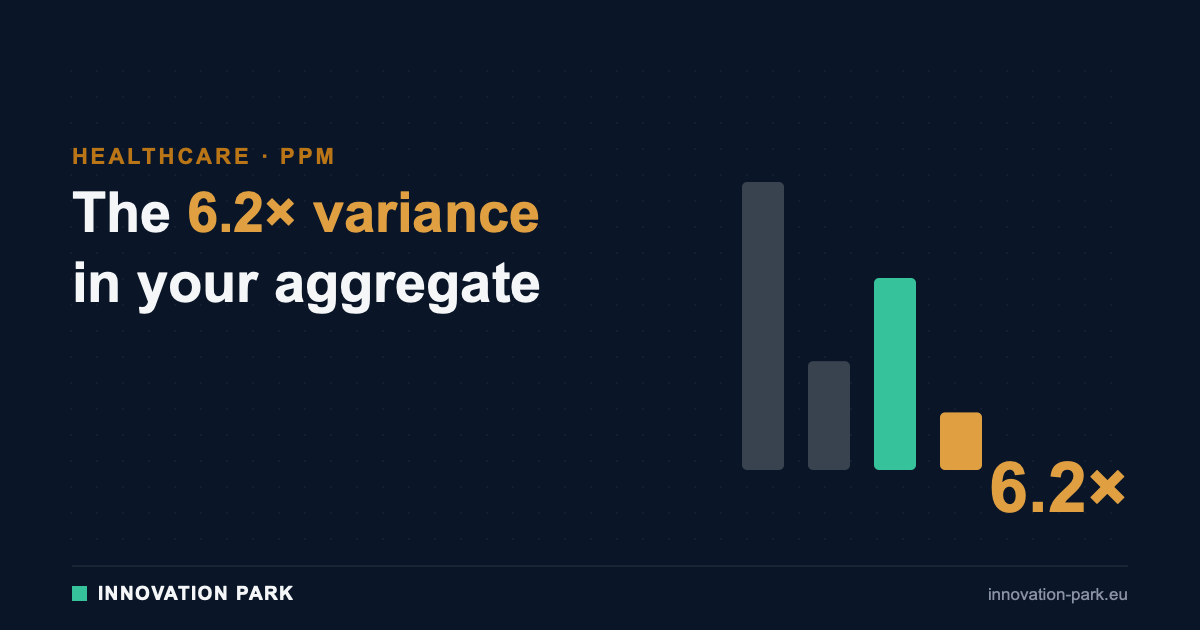
In multi-location dermatology and specialty PPMs, the best locations convert referrals into completed visits at several times the rate of the worst — in one portfolio, 6.2× top to bottom — despite the same brand and playbook. The portfolio aggregate hides it because a sum discards the distribution: total referrals and visits look healthy while a third of locations underconvert. You close the gap by diagnosing what the top sites do differently, standardising it, and reactivating the referral relationships that have gone quiet at the weak sites.
- Same playbook, very different results. Conversion variance across locations is the largest hidden lever in a PPM.
- The aggregate conceals it. Portfolio totals average strong and weak sites into a healthy-looking number.
- The gap is operational, not market. Intake speed, scheduling friction, and referrer follow-up explain most of it.
- Closing it needs no new system — standardise the top sites' practices and reactivate dormant sources at the bottom.
The variance nobody sees
Ask a PPM operator how their referral engine is doing and you get a portfolio number: total referrals, total new patients, maybe a blended conversion rate. The number is usually fine. What it hides is that the locations behind it are not remotely alike. The strongest site takes a referral and turns it into a completed, billable visit at a multiple of the rate of the weakest — and both are running the same brand standards, the same EMR, the same referral marketing. In one portfolio we measured, the top-to-bottom conversion variance was 6.2×.
That variance is the single largest lever most PPMs are not pulling. You do not need more referrals to grow; you need your weak locations to convert the referrals they already receive the way your strong ones do. But you cannot manage a gap you cannot see, and the aggregate guarantees you cannot see it.
Why the aggregate hides it
The arithmetic is the same failure mode that hides dormant relationships. An aggregate is a sum, and a sum throws away the distribution that produced it. A portfolio converting referrals at a healthy blended rate can contain a cluster of locations converting at half that, offset by a few stars. The blended number moves only when the problem is already severe. By reporting at the portfolio level, you have averaged your worst-performing sites into invisibility and removed your ability to act early.
How much revenue is your conversion variance costing?
The free Revenue Recovery tool estimates the recoverable referral revenue across your locations. Five inputs, no email required.
Open the free tool →What separates top from bottom
When you score each location against its own referral base and against its peers, the causes of the variance are remarkably consistent. Intake speed — how fast a referred patient is contacted — explains a large share; the best sites reach out within hours, the worst within days, by which point the patient has gone elsewhere. Scheduling friction is next: how many steps and how long until the patient has an appointment they keep. Then referrer follow-up: whether the referring physician hears back that their patient was seen, which determines whether they refer again. Finally, dormant-source reactivation: the weak sites have usually let more referral relationships go quiet, compounding the gap.
Closing the gap
Closing the variance is not a technology project; it is a diagnosis-and-standardisation one. The Revenue Lens scan identifies which locations underconvert and why, ranks the recoverable revenue, and surfaces the dormant referral sources at each weak site by name. The fixes — faster intake, lower scheduling friction, closed-loop referrer follow-up, structured reactivation — are then standardised from what the top locations already do. All of it runs inside your existing CRM and practice-management stack. On qualifying $30M+ engagements, our 3× fee recovery guarantee applies: we recover at least three times our fee, or we keep working at no additional fee until we do.
FAQ.
What is referral conversion variance in a PPM?
The gap between how effectively your best and worst locations turn a referral into a completed visit. In multi-location dermatology and specialty PPMs we routinely see several-fold variance — 6.2× top to bottom in one portfolio — across sites on the same brand and playbook. The aggregate hides it by averaging strong and weak together.
Why doesn't our dashboard show this?
Because dashboards report the aggregate, and an aggregate is a sum that discards the distribution. Totals can look healthy while a third of locations underconvert. Variance only appears when each location is measured against its own referral base and against peers.
How do you close the variance?
By diagnosing what the top locations do that the bottom ones don't — intake speed, scheduling friction, referrer follow-up, dormant-source reactivation — then standardising those practices and reactivating the quiet referral relationships at the weak sites, inside the existing stack.
How to start.
Here is the fastest path to a real answer. No leap. A stair.
Run the free tool
Five inputs. Sixty seconds. A benchmark-calibrated recoverable-revenue range across your locations. No email required.
How AI finds the variance
The relationship-graph mechanism that surfaces underconverting sites and dormant sources by name.
Book a 30-min qualification call
Tyler personally. We scope the diagnostic against your locations. No pitch.