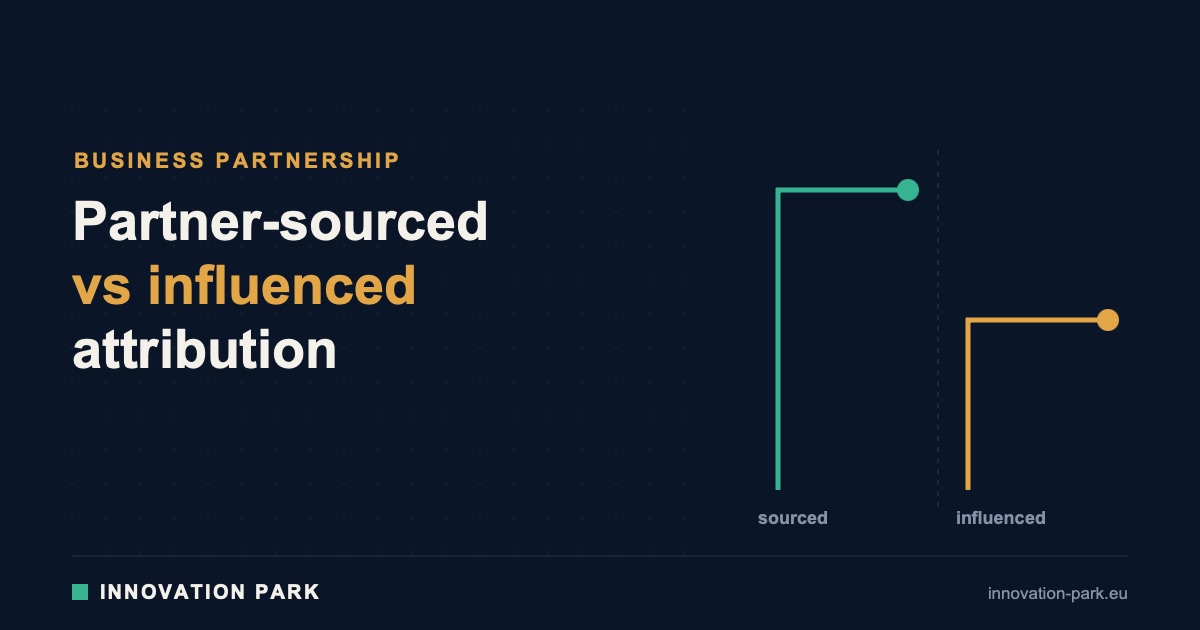
Partner-sourced revenue is a deal the partner originated; partner-influenced revenue is a deal they touched but did not originate. Most programs blend the two into one attributed number with no rule for what earned the credit, which a diligence team strikes in minutes. A defensible attribution policy has four parts: a written sourced-vs-influenced definition, a primary-credit rule so no dollar is double-counted, a timestamped CRM audit trail tying each dollar to a partner action, and consistent application across every deal and period. Defensibility comes from the documented method, not the size of the number.
- Sourced and influenced are different assets. One is origination, one is acceleration; blending them inflates the program and fails diligence.
- The number fails on governance, not truth. Buyers strike attribution they cannot trace, regardless of whether the revenue is real.
- Four rules make it defensible. Definition, primary-credit, audit trail, consistency.
- Governance is what gets paid for. A documented policy turns reported partner revenue into a value a buyer will underwrite.
Two numbers wearing one label
Walk into most SaaS or association partner programs and ask what the channel produced last year, and you get one number: attributed partner revenue. It is almost always wrong — not in arithmetic, but in category. Folded inside that single figure are two fundamentally different things.
The first is partner-sourced revenue: deals the partner originated. Without the partner, the opportunity does not exist. The second is partner-influenced revenue: deals the partner touched — accelerated, expanded, de-risked, or referenced — but did not originate. The company would likely have found the deal anyway; the partner made it better, faster, or larger.
Both are real. Both have value. But they are not the same asset, and a program that reports them as one number has, without meaning to, made its most important revenue line impossible to trust.
Why diligence disqualifies the blend
Put that blended number in front of a buyer's deal team and watch what happens. Their first question is "how much of this is sourced?" If the answer is a rule applied consistently with an audit trail behind it, the conversation continues. If the answer is a shrug, the number is discounted heavily or struck from the model entirely.
This is the part operators consistently underestimate: the figure fails not because the revenue is fabricated but because the governance is undocumented. A buyer cannot distinguish origination from influence, cannot test the attribution against the CRM, and cannot confirm that the same dollar was not credited to two partners or to a partner and a direct rep at once. Faced with an untestable number, a careful buyer does the only rational thing — applies a large haircut. Programs routinely lose six and seven figures of credited value at this step, in minutes, on governance grounds alone.
Could your partner-revenue number survive a diligence cross-examination?
The Partnership Revenue Maturity Assessment scores your attribution governance, concentration awareness, and reactivation discipline across twelve questions. Five minutes, no email required.
Take the assessment →The four rules of a defensible policy
A partner-revenue number is defensible when four things are true at once. None of them is technically hard; what is hard is the discipline to apply them on every deal, every quarter, without exception.
1. A written sourced-vs-influenced definition
One document, agreed before the period starts, stating exactly what qualifies a deal as sourced and what qualifies it as influenced. The definitions must be specific enough that two people scoring the same deal reach the same answer. Ambiguity is what diligence attacks first.
2. A primary-credit rule
Every dollar gets exactly one primary owner. If a partner sourced a deal that a second partner later influenced, the rule decides who carries the dollar and how the secondary contribution is recorded — without ever counting the dollar twice. Double-counting across partners, or across partner and direct rep, is the most common single defect and the easiest for a buyer to expose.
3. A timestamped audit trail
Each attributed dollar must trace to a specific partner action recorded in the CRM at the time it happened — a registered deal, a logged introduction, a documented co-sell. Attribution assigned retroactively, after the deal closed, is worth nothing in diligence because it cannot be distinguished from back-fitting.
4. Consistent application
The policy must be applied identically across every deal and every reporting period. A rule that flexes to flatter a given quarter is not a rule; it is a narrative, and buyers price narratives at zero.
Defining sourced vs influenced
The practical test we use is origination counterfactual: if the partner had not existed, would this specific opportunity have entered the pipeline at all? If no, it is sourced. If the opportunity would have arrived through other means and the partner made it close faster, larger, or safer, it is influenced. The counterfactual is not always clean, which is exactly why the rule has to be written and the edge cases adjudicated the same way every time.
Reported correctly, the two numbers tell a buyer different and more valuable things. Sourced revenue speaks to the channel's ability to generate net-new demand — a growth asset. Influenced revenue speaks to the channel's ability to improve win rates and deal size — an efficiency asset. A program that can show both, cleanly separated, is worth far more than one that shows a larger blended figure nobody can decompose.
The audit trail that closes it
The audit trail is where governance becomes real. It does not require new software; it requires that your existing CRM enforce, at the moment of the partner action, the fields that prove attribution: which partner, what action, what date, sourced or influenced, primary or secondary. When those fields are mandatory and timestamped, the attribution number stops being a claim and becomes a query — anyone can reproduce it from the underlying records. That reproducibility is the entire difference between a number a buyer underwrites and a number a buyer strikes.
From reported number to balance-sheet asset
The reason this matters beyond a clean report is the transaction. When a sponsor evaluates a business with a meaningful partner channel, the credibility of the partner-revenue line directly affects the multiple. A governed, decomposable, auditable partner-revenue number is underwritten close to face value. An ungoverned blend is discounted or excluded. The same underlying revenue is worth materially more or less depending entirely on the governance wrapped around it.
That is the work: not generating partner revenue, but making the partner revenue you already have legible to the one audience whose opinion sets its price. Build the policy before you need it, because the quarter you discover you need it is the quarter you can no longer build it retroactively.
FAQ.
What is the difference between partner-sourced and partner-influenced revenue?
Partner-sourced revenue is a deal the partner originated — without them the opportunity does not exist. Partner-influenced revenue is a deal the partner touched but did not originate; they accelerated, expanded, or de-risked it. Conflating the two inflates a program's apparent value and is the fastest way to fail channel-revenue diligence, because the categories carry different defensibility and economics.
Why do diligence teams disqualify partner attribution numbers?
Because most programs report one blended figure with no rule for what earned attribution, no primary-credit logic, and no audit trail. A buyer cannot separate sourced from influenced, cannot test the number against the CRM, and therefore discounts it heavily or strikes it. The figure fails on undocumented governance, not on whether the revenue is real.
What makes a partner attribution policy defensible?
A written sourced-vs-influenced definition, a primary-credit rule so no dollar is counted twice, a timestamped CRM audit trail tying each attributed dollar to a specific partner action, and consistent application across every deal and period. Defensibility comes from the documented method, not the size of the number.
How to start.
Here is the fastest path to a real answer. No leap. A stair.
Take the maturity assessment
Twelve questions across attribution governance, concentration risk, and reactivation discipline. Score 0–40. No email required.
See the partnership practice
How Innovation Park builds and governs partner-revenue systems — the engagement behind the $120M association channel.
Book a 30-min qualification call
Tyler Opsahl personally. We pressure-test your attribution model and scope what a governance build would take. No pitch.